
2025 SEO Guide: Master Keyword Research, On-Page & Technical SEO
Complete Guide to SEO for Business Websites in 2025
If you have a business website you have probably heard people talk about SEO a lot. Maybe someone told you that you need it or you read something that said it's not important anymore. I want to set the record straight: SEO is still important. It has just changed. The days are gone when you could write a blog post with the keyword fifty times and get to the top of Google. In 2025 search engines are smarter than ever. They don't just look at what you write; they try to understand what you are trying to say. They want to know if your business can really solve the problem the user is searching for. At Nishkarsh.solution we have spent the year learning about these changes. Here is my simple guide to getting SEO right, for your business in 2025. We will cover four things: * Keyword Research * On-Page SEO * Technical SEO * Backlinks Lets get started. .
This guide will walk you through the essential SEO strategies for business websites in 2025, covering keyword research, on-page SEO, technical SEO, and backlinks. We’ll also provide real-world examples to help you implement these strategies effectively.
Keyword Research: The Foundation of SEO
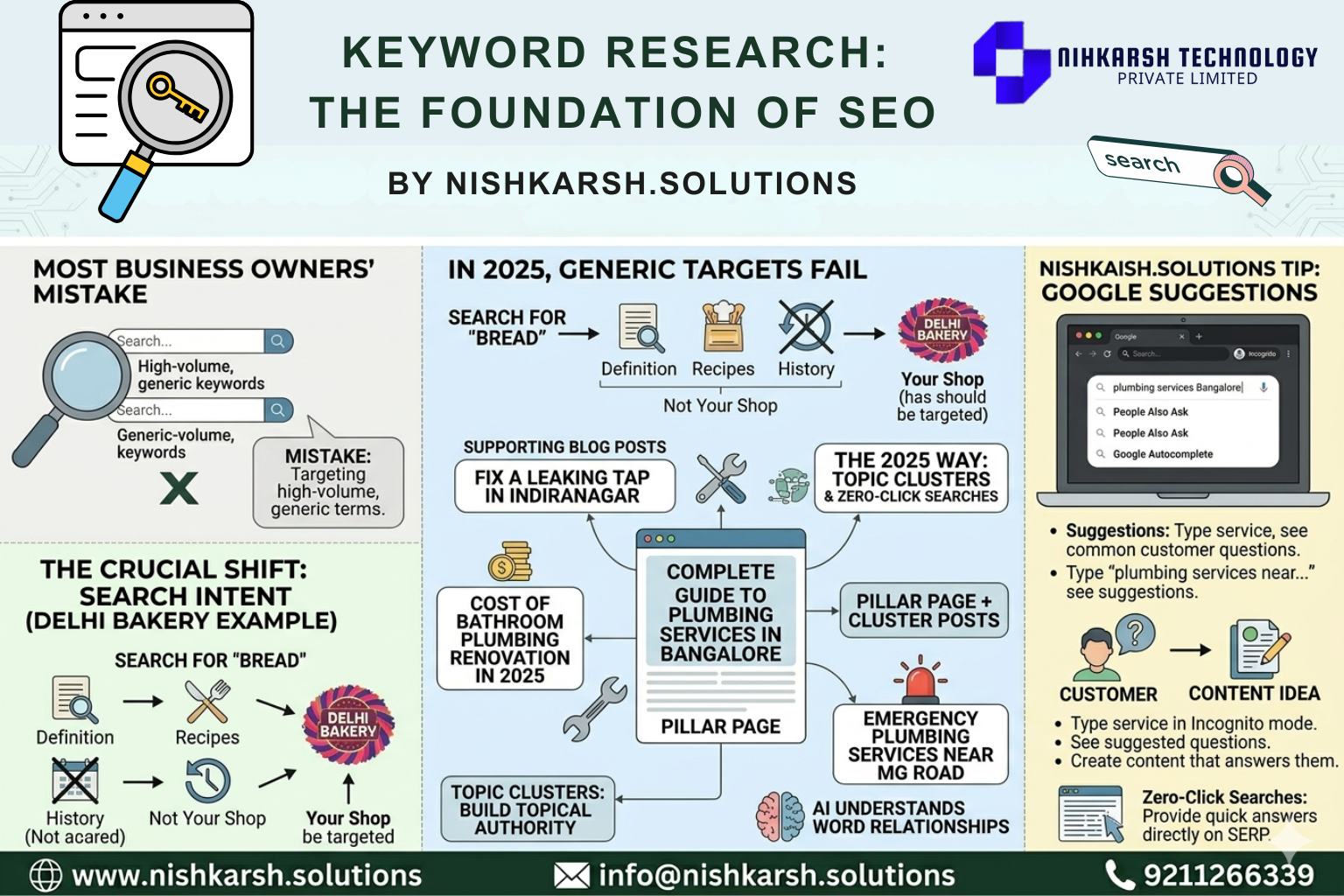
Most business owners make a mistake. They use a keyword tool find a term with lots of searches and try to rank for it.. In 2025 this will not work. The problem is "Search Intent". If you have a bakery in Delhi ranking for "bread" won't help. Many people search for it. They want a definition, recipes or history. Not your shop. The 2025 way is to use Topic Clusters and Zero-Click Searches. Instead of one keyword, target topics. Google uses AI to understand word relationships. Here's an example: You run a plumbing business in Bangalore. Old way: Target "plumber Bangalore". Way: Create a topic cluster. * Pillar Page: "Complete Guide to Plumbing Services in Bangalore" * Blog Post A: "Fix a leaking tap in Indiranagar" * Blog Post B: "Cost of bathroom plumbing renovation in 2025" * Blog Post C: "Emergency plumbing services near MG Road" This way you catch customers at stages. When they research costs have an emergency or need a specific service. My tip: Use Google Autocomplete and "People Also Ask". Type your service, in Incognito mode. See Googles suggestions. These are questions customers are asking. Use them for your content.
2. On-Page SEO: Writing for Humans, Structured for Bots
On-page SEO is simply how you optimize the content on your website. Many people think this is just about adding a keyword to the title. It’s actually about structure and readability. In 2025, Google’s algorithm (often called the "Helpful Content System") rewards clarity. It wants to see that a human can easily navigate the page and find the answer immediately. Real Example: A "Services" Page Makeover Imagine you own a Digital Marketing Agency like Nishkarsh.solution. You have a page for "Social Media Marketing." The Bad Page: A giant paragraph of text saying "We are the best at Instagram and Facebook. We love marketing. Contact us." There are no headings, just a wall of text. The Good Page (2025 Style): H1 Heading: Social Media Management Services for Local Businesses H2 Heading: 1. Instagram Marketing Content: Specific strategies for Reels and Stories. H2 Heading: 2. Facebook Advertising Content: How we target local demographics. H2 Heading: Our Process (Step-by-step) Schema Markup: This is a hidden code we add that tells Google exactly what this page is about (a Service). Why this works: Google reads the H2s like a table of contents. It immediately understands that this page offers Instagram help and Facebook help. Plus, the user can scan the page and find what they need in 5 seconds. My Action Tip: Add "FAQs" to the bottom of every service page. Use the actual questions customers ask you in real life. This targets voice search (people talking to Siri/Alexa) and takes up valuable real estate in Google search results.
- Informational: Users looking for answers to questions (e.g., "How to build a website").
- Commercial: Users ready to buy (e.g., "Best running shoes 2025").
- Navigational: Users seeking a specific website (e.g., "Amazon login").
Example: If you run a fitness blog, targeting "best home workout equipment" (informational) and "affordable dumbbells under $50" (commercial) will attract more relevant traffic than just targeting "workout equipment."
3. Technical SEO: The Foundation (Speed and Mobile)
You can have the content in the world but if your website is really slow you will not rank. In 2025 Technical SEO is mostly about how people feel when they use your website, which is called User Experience. Google has something called Core Web Vitals. These are like scores for how fast your page loads how stable it's when it is loading and how quickly you can interact with it. Let me give you an example. Imagine you have a store that sells handmade jewelry. You have a lot of pictures of jewelry. The problem is that those pictures are really big and they slow down your website. When someone clicks on your link from Google it takes a time to load, like 6 seconds. Google sees that most people leave your website away. To fix this problem we can make the pictures smaller without making them look bad. We can use tools like TinyPNG to do this. We can also use something called Lazy Loading, which means the pictures only load when someone scrolls down to them. It is also important to remember that Google looks at your website on a phone first. If your website looks good on a computer but is hard to use on a phone you will not show up in search results. My tip is to use Google Search Console it is free. Look for the Core Web Vitals report it will tell you which pages of your website are slow and why. It is like a doctor telling you what is wrong, with your car so you can fix it..
Example: If you sell eco-friendly cleaning products, using Ahrefs to find long-tail keywords like "best biodegradable dish soap for sensitive skin" can help you rank for niche queries with lower competition.
3. Analyzing Competitors
Studying your competitors’ keyword strategies can reveal gaps in your own approach. Use tools like SpyFu or Ubersuggest to see which keywords your competitors are ranking for and how they’re optimizing their content.
Example: A competitor in the SaaS industry might rank for "best project management software for remote teams." By analyzing their content, you can create a similar piece with unique insights.

On-Page SEO: Optimizing Your Content
On-page SEO involves optimizing individual web pages to rank higher in search results. In 2025, search engines like Google prioritize high-quality, user-friendly content. Here’s how to optimize your pages effectively:
4. Backlinks: Digital Reputation Management
Meta titles and descriptions are critical for both SEO and user experience. They should be concise, keyword-rich, and compelling.
Example: A blog post about "How to Start a Blog in 2025" should have a meta title like "How to Start a Blog in 2025: A Step-by-Step Guide" and a description like "Learn the best practices for starting a successful blog in 2025 with this comprehensive guide."
2. Optimizing Headings and Content Structure
Using proper heading hierarchy (H1, H2, H3) helps both users and search engines understand the structure of your content. The H1 should include your primary keyword, and subheadings should break down the content logically.
Example: A guide on "Digital Marketing Strategies for Small Businesses" should have an H1 for the main topic and H2s for sections like "SEO," "Social Media," and "Email Marketing."
3. Improving Readability and Engagement
Google’s E-A-T (Expertise, Authoritativeness, Trustworthiness) guidelines emphasize the importance of high-quality, engaging content. Use short paragraphs, bullet points, and multimedia to enhance readability.
Example: A tutorial on "How to Use Canva for Social Media Graphics" should include screenshots, step-by-step instructions, and a call-to-action (CTA) to download a free template.

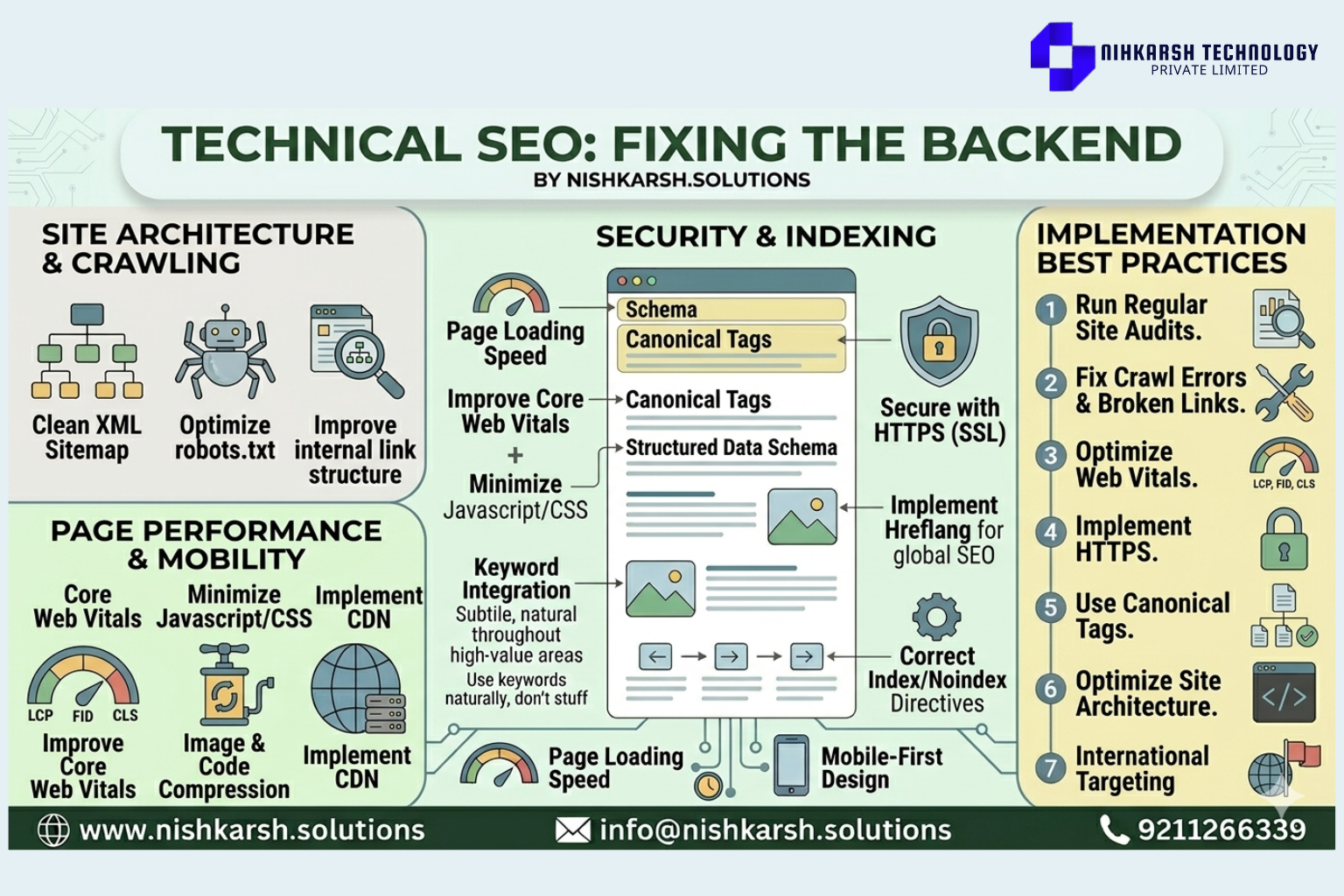
Technical SEO: Fixing the Backend
Technical SEO ensures that search engines can crawl and index your website efficiently. In 2025, core web vitals and mobile-first indexing are more important than ever. Here’s how to optimize your site’s technical aspects:
1. Improving Page Speed
Slow-loading pages hurt user experience and rankings. Use tools like Google PageSpeed Insights or GTmetrix to identify and fix issues like image optimization, minification, and server response time.
Example: Compressing images using tools like TinyPNG or enabling browser caching can significantly improve load times.
2. Ensuring Mobile-Friendliness
With over 60% of searches coming from mobile devices, having a responsive design is non-negotiable. Google’s mobile-first indexing means mobile performance is prioritized in rankings.
Example: Testing your site on Google’s Mobile-Friendly Test tool and using CSS media queries to ensure proper scaling on all devices.
3. Fixing Crawl Errors
Use Google Search Console to identify and fix crawl errors like broken links, duplicate content, and server errors. Regularly audit your site to maintain a healthy crawl rate.
Example: A 404 error on a product page can hurt rankings. Redirecting it to a relevant page or creating a new one can resolve the issue.
Backlinks: Building Authority and Trust
Backlinks are links from other websites to yours. In the eyes of Google, a backlink is a "vote of confidence." It’s like a citation in a research paper. However, not all votes are equal. In 2025, quality is everything. A link from a spammy directory can actually hurt you more than help you. Real Example: The Local Restaurant Imagine you own a restaurant in Pune. You want backlinks. Bad Backlink: Paying $5 to get listed on a random website called "best-websites-in-the-world-123 dot com." Google ignores this. Good Backlink (2025 Strategy): You host a charity food event for a local school. The local news website or a popular Pune food blogger writes a story: "Downtown Bistro Raises Funds for City School." They link back to your website as the source. That link from the local news site is pure gold. It tells Google: "This restaurant is an authority in Pune. They are a real business doing real things." The "Guerilla" Tactic: If you are a B2B business (like a consultant or agency), write a detailed case study about a result you got for a client. Ask the client if they would feature it on their blog or LinkedIn. If a supplier or partner links to you, it shows you are trusted by other businesses in your industry.
Final Thoughts from Nishkarsh.solution
SEO in 2025 is a marathon, not a sprint. If someone promises you "Page 1 rankings in 24 hours," run the other way. They are likely using black-hat tricks that will get your site banned. The secret is consistency. Do the keyword research properly. Write clear pages for your users. Fix your technical speed issues. And build genuine relationships to get good backlinks. If you take it step by step, the traffic will come—and more importantly, it will be the right traffic: people actually looking to buy what you sell. .