
NGO Registration in India: Hassle-Free Guide + Expert Support
NGO Registration in India: Complete Guide + Hassle-Free Setup with Expert Support
NGO Registration in India is a deal for people who want to make a difference.
You have a vision for something. You are really passionate about it. You want to fix one thing that is not working like helping kids who do not have much money to go to school or saving animals that do not have homes or helping women in rural areas become stronger. Then you have to deal with a lot of paperwork. This can be very frustrating. Your dream of making the world a better place gets buried under a pile of government forms and confusing legal words. You even have to figure out which law you need to follow to register your organization. If this sounds like what you're going through you should know that you are not the only one. Every year a lot of people, in India who want to make a difference get stuck at the beginning. They have to register their non government organization. The process seems easy when you look at it. It is actually very hard to do. Nishkarsh Solutions has helped a lot of people start their organizations. Now I am going to show you how to do it. By the time you finish reading this you will know what kind of registration you need, how to do it step by step and how to avoid waiting for a time. Lets make things clear and get started with Nishkarsh Solutions and the process of NGO registration.
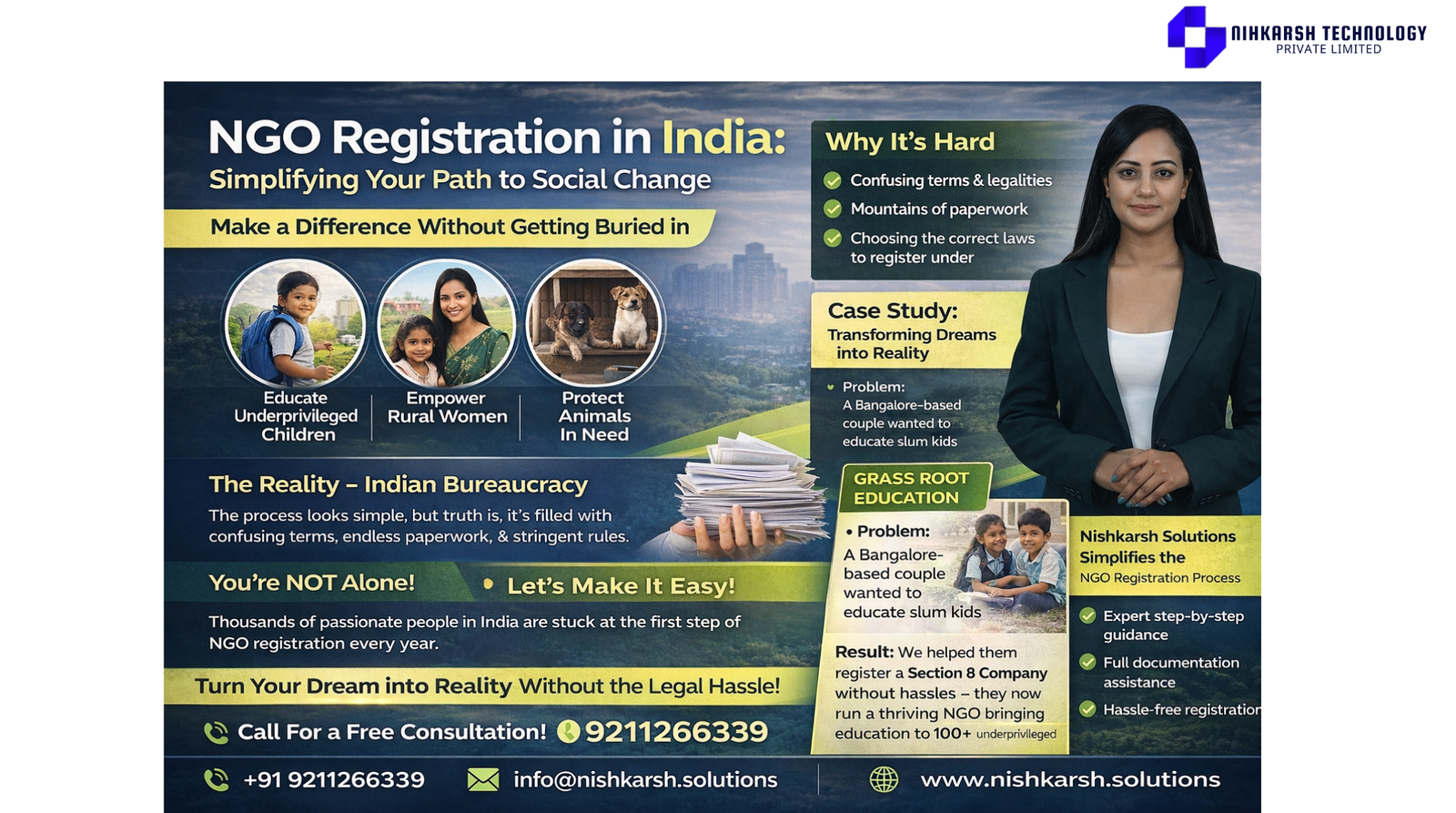
The "Great Wall" of Indian Bureaucracy (The Problem)
Imagine this: Rohan, a software engineer from Bangalore, wants to start a trust to teach coding to government school kids. He writes a beautiful vision document, gathers three friends, and goes to the local office to register. He is told he needs a "Trust Deed." He writes one from a sample he found online. He is told it needs to be on stamp paper. He buys stamp paper. He is told it needs to be witnessed by two people. He brings witnesses. He is told the "object clause" is too vague. He is sent back. Three weeks later, he is still stuck. His enthusiasm is gone. The money he saved for a laptop for a student is now spent on travel and photocopies. This is the reality of NGO registration in India. The process isn't necessarily difficult, but it is intolerant of mistakes. A single comma out of place in your "Object Clause" can get your application rejected. A wrong choice between a Trust and a Society can create tax problems years later. You need a map. You need a checklist. And often, you need a guide.
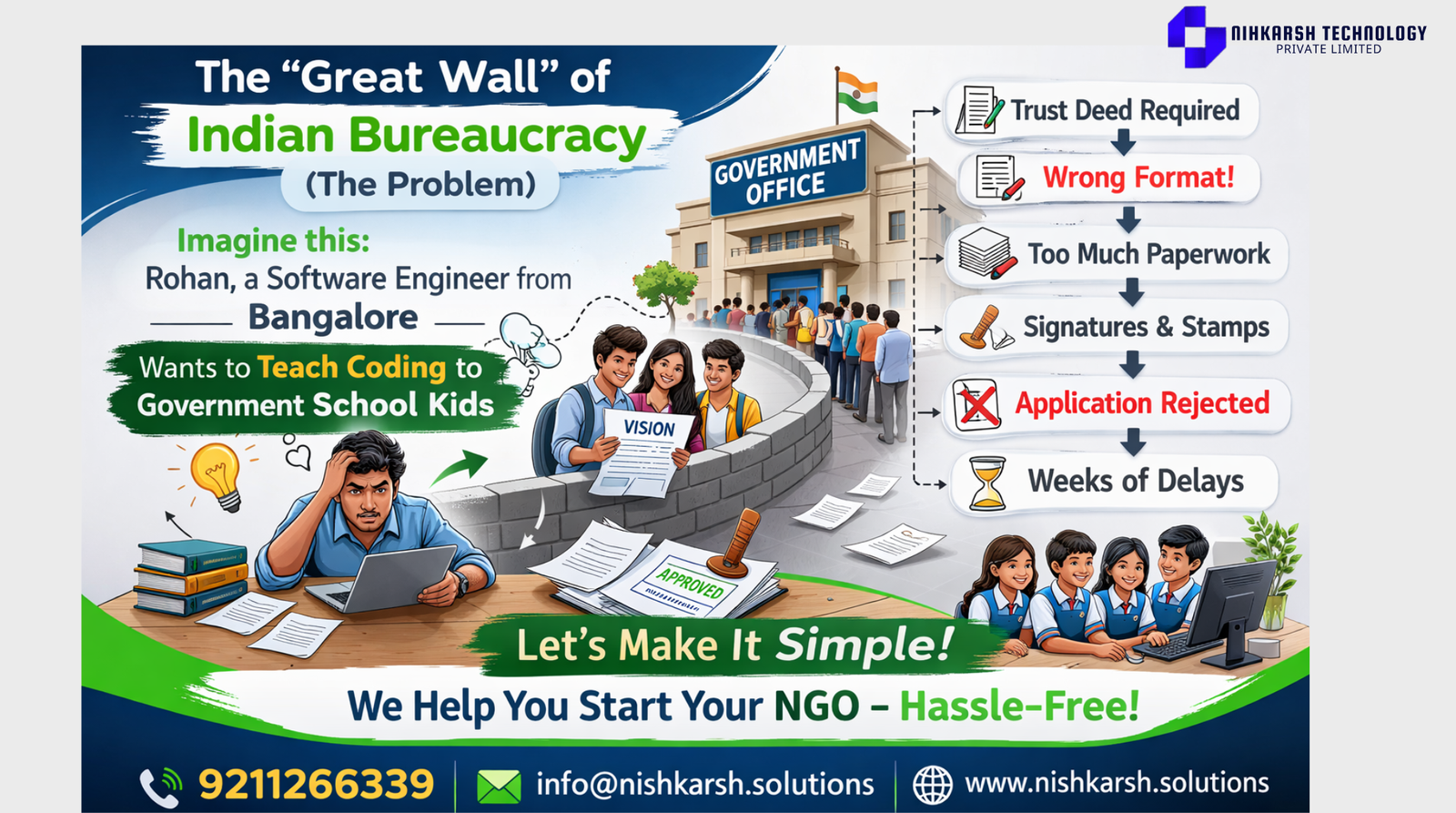
Step-by-Step Solution: How to Register Your NGO in India
Before you file a single form, you must answer the most important question: What legal structure do I need? In India, a non-profit can be registered under three primary acts. Your choice determines how you operate, how you handle money, and how you report to the government.
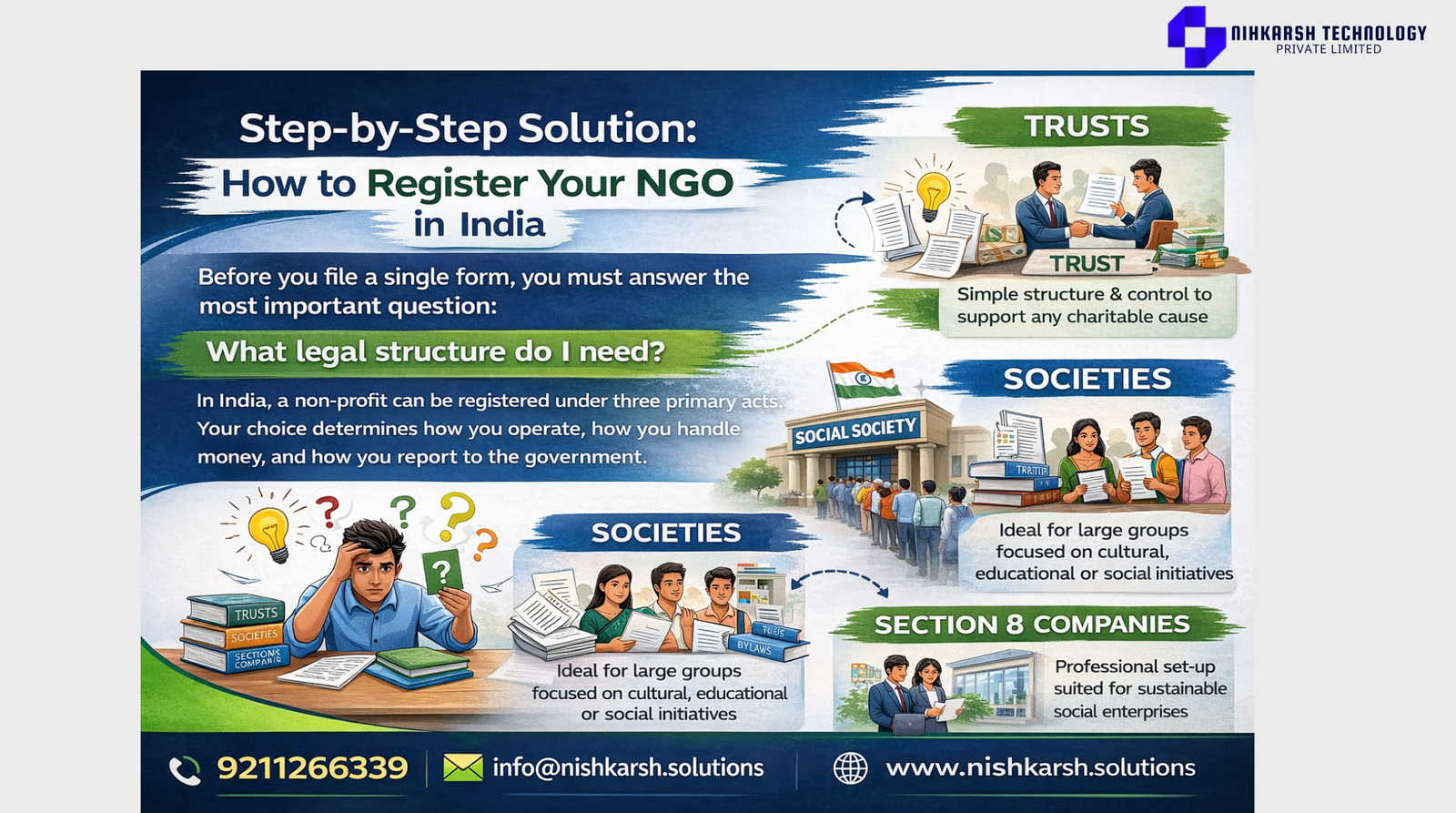
Step 1: Choose Your Entity (The Big Decision)
There is no "one-size-fits-all" here. Let's break it down:
1. The Trust (The Most Common)
Governing Law: Indian Trusts Act, 1882 (or local state acts). This Indian Trusts Act, 1882 is for people who want to do things for others. It is ideal for family-run philanthropic activities or charitable work that helps people get an education healthcare or relief when they need it. To set this up you need least 2 trustees and these are usually the founders. The Indian Trusts Act, 1882 has a simple structure, which is not as complicated as a Society. The Indian Trusts Act, 1882 is best for to medium-sized local initiatives that want to make a difference, in their community.
2. The Society (The Democratic Body)
Governing Law: Societies Registration Act, 1860. ## Who is it for? It is ideal for groups of people who share an interest. Examples include clubs and cultural groups. Larger welfare organizations also use it. The group needs a governing body. Must be set up democratically. ## Structure The group needs least 7 members in most states. It has a President, a Secretary and a Treasurer. ## Best, for It suits organizations where people pay to be members. Professional bodies and groups that want to make decisions in a way also use it. These groups prefer a Societies Registration Act setup.
3. Section 8 Company (The Professional Corporate NGO)
Governing Law: Companies Act, 2013. Who is it for? This is ideal for players who want to be seen as very credible. The Section 8 Company is strictly. It gives the highest level of trust from donors and the government. The Section 8 Company structure requires a minimum of 3 directors. The Section 8 Company is governed in a way to a private limited company but it operates for a non-profit purpose. The Section 8 Company is best for NGOs that need foreign funding or corporate grants or high-level government collaborations. Expert Tip, from Nishkarsh: If you are just starting out locally with friends a Trust is the cheapest option. If you plan to scale up and take government grants you should consider a Society. If you want to attract corporate CSR funds from the very beginning you should go for a Section 8 Company.

Step 2: The Documentation Drill
When you have chosen your structure it is time to gather all the paperwork. This is the part where most people make mistakes. The Non-Negotiable Documents: The Memorandum or Trust Deed is like a constitution for your non government organization. This document must have the following information: * The name of your non government organization, which has to be unique and not similar to any one. * The address of the registered office. * The. Objectives of your non government organization, which you should write very carefully. These goals and objectives should be broad enough to cover the projects you will do in the future. Also specific enough to pass scrutiny. * The details of the people who will be in charge such as the trustees or members. * The. Regulations for running your non government organization. You will also need to give proof of identity, such as a PAN Card, an Aadhaar Card or a Voter ID for all the people who are starting the non government organization. Additionally you need to give proof of the address of the registered office, such as an electricity bill. If you are renting the office you need to get a No-Objection Certificate, from the landlord. You should also include passport size photographs of all the members of your non government organization.
Step 3: The Registration Process (The Actual Filing)
The process differs a bit from state to state. It generally works like this: For a Trust: * You need to create a Trust Deed document. * You then print it on paper called stamp paper. The cost of this paper is different in each state. * All people involved in the trust and witnesses need to sign the document. * Next you submit the deed and some papers to the office of the Sub-Registrar. * You have to pay a fee for registration. * The Sub-Registrar keeps one copy of the document. They give you back the registered copy. For a Society: * You have to organize a meeting. In this meeting you decide to form the society. * Then you prepare a document called Memorandum of Association and some rules. * After that you submit a request to the Registrar of Societies in your state. * You must provide details of all people in charge of the society. * They check everything. Then they give you a Certificate of Registration. For a Section 8 Company: * First you get certificates for digital signatures. You also get identification numbers for all directors. * Next you ask the Ministry of Corporate Affairs to approve your company name. * Then you submit the Memorandum of Association and Articles of Association with a form called SPICe+. * You request a Section 8 license, from the Registrar of Companies. * Once they approve you get the Certificate of Incorporation.
Case Study: From Confusion to Clarity
The Client: The Green Mile Foundation (Name changed for privacy) The Problem: A group of five environmental activists in Lucknow wanted to start a massive tree-plantation drive and also set up a research wing for studying local flora. They came to us confused. They had already spent ₹15,000 on a lawyer who told them to register as a Trust, but their donor (a PSU) was insisting on a "more professional structure." The Nishkarsh Solution: We sat down with the founders and analyzed their roadmap. Short-term goal: Get local donations and start planting. Long-term goal: Receive government research grants and corporate CSR. A simple Trust would not have the credibility for the research grants. A full Section 8 Company was too heavy for their current operational capacity. The Verdict: We recommended a Society. It gave them the democratic structure needed for research bodies. It was cheaper and less compliance-heavy than a Section 8 Company. It satisfied the donor's need for a formal "Governing Body." We handled the entire registration process, ensured their "Object Clause" covered both plantation and research, and got them registered in 4 weeks. They are now successfully running two concurrent projects. Moral of the story: Choosing the right structure at the start saves you years of legal and financial trouble later.
The "Hassle-Free" Reality Check (Conclusion)
Starting an NGO is a brave thing to do. The paperwork is something you have to do to get started it is not the main thing. You can do all the paperwork yourself. You can sit at your computer for hours looking at government websites go to the registrars office a lot of times and finally figure it out.. Is that really how you want to use your time? Your time is better spent getting money for your NGO finding people to help you and actually helping people. The registration process is something you have to do to get to the stuff it is not the good stuff itself. That is where having someone who knows what they are doing can make a difference. They can take something that's really annoying and make it easy like just checking something off a list.
Ready to Start Your Journey? Let’s Do This Together.
Don't let paperwork slow down what you want to do. If you are a doctor who wants to start a clinic or a teacher who wants to start a school in a rural area we, at Nishkarsh Solutions can help make the registration process easy, quick and fully correct. We take care of all the paperwork so you can focus on helping people. * Call us now for a consultation: +91 9211266339 * Send us an email: info@nishkarsh.solutions * Check out our website: www.nishkarsh.solutions Lets make your dream a real registered thing.
Frequently Asked Questions (FAQ)
Q1: How much does it cost to register an NGO in India?
A: It varies by state and type. A Trust can be relatively inexpensive (stamp paper + lawyer fees), while a Section 8 Company costs more due to central government filing fees. Contact us for a customized quote based on your state and structure.
Q2: How long does the registration process take?
A: A Trust can be registered in 1-2 weeks if the deed is ready. A Society usually takes 4-6 weeks. A Section 8 Company can take 4-8 weeks depending on MCA approval.
Q3: Can a foreigner be a trustee of an Indian NGO?
A: Yes, but it is subject to strict regulations and prior approval from the Ministry of Home Affairs, especially if the NGO intends to receive foreign funds (FCRA). It's a complex area and requires expert legal advice.
Q4: What is the 12A and 80G registration?
A: Once your NGO is registered, you need to apply for 12A (which grants tax exemption to the NGO) and 80G (which allows donors to claim a tax deduction). These are separate applications filed with the Income Tax Department.
Q5: My NGO is registered. Now what?
A: Congratulations! Now begins the real work. You must maintain proper accounts, hold annual general meetings (for Societies/Section 8), file annual returns, and ensure compliance to keep your registration active. If you need help with compliance, Nishkarsh Solutions can assist with that too!